New PCPP-32-101 Test Materials & PCPP-32-101 Exam Dumps Collection
P.S. Free & New PCPP-32-101 dumps are available on Google Drive shared by BraindumpsPrep: https://drive.google.com/open?id=1Su-XZlQmcq0-XnE3M0blm-F3mVAXY9x1
The BraindumpsPrep is committed from the day first to ace the PCPP1 - Certified Professional in Python Programming 1 (PCPP-32-101) exam questions preparation at any cost. To achieve this objective BraindumpsPrep has hired a team of experienced and qualified Python Institute PCPP-32-101 certification exam experts. They utilize all their expertise to offer top-notch PCPP1 - Certified Professional in Python Programming 1 (PCPP-32-101) exam dumps. These PCPP-32-101 exam questions are being offered in three different but easy-to-use formats.
Python Institute PCPP-32-101 Exam Syllabus Topics:
| Section | Weight | Objectives |
|---|---|---|
| Network Programming | 20% | - Communication and networking
|
| File Processing and Serialization | 15% | - Data storage and transfer
|
| GUI Programming | 20% | - Graphical user interfaces with Tkinter
|
| Advanced Object-Oriented Programming | 25% | - Object-oriented concepts
|
| Multithreading and Concurrency | 10% | - Concurrent programming
|
| Python Standard Library and Best Practices | 10% | - Advanced Python development
|
>> New PCPP-32-101 Test Materials <<
2026 Python Institute PCPP-32-101: PCPP1 - Certified Professional in Python Programming 1 First-grade New Test Materials
When it comes to PCPP-32-101 exam, many candidates are lack of confidence to pass it. But we all know self-confidence is the spiritual pillar of a person as well as the inherent power, which is of great importance and value to a person who want to pass the PCPP-32-101 exam. Our material include free Demo, you can go for free it of the PCPP-32-101 Materials and make sure that the quality of our questions and answers serve you the best. You are not required to pay any amount or getting registered with us for downloading free PCPP-32-101 materials. You can improve your confidence in the exam by learning about real exams through our free demo.
Python Institute PCPP1 - Certified Professional in Python Programming 1 Sample Questions (Q17-Q22):
NEW QUESTION # 17
Select the true statement about the
socket. gaierror exception.
- A. It is raised when a timeout occurs on a socket.
- B. It is raised when an address-related error caused by the getaddrinfo () and getnameinfo () functions occurs.
- C. It is raised when an address-related error caused by the repr () function occurs.
- D. It is raised when a system function returns a system-related error.
Answer: B
Explanation:
Explanation
The socket.gaierror exception is raised when
an address-related error caused by the getaddrinfo() and getnameinfo() functions
occurs. These functions are used to translate hostnames to IP addresses and vice
versa, and the gaierror exception is raised if they fail to perform this
translation.
NEW QUESTION # 18
Analyze the following function and
choose the statement that best describes it.
- A. It is an example of decorator stacking.
- B. It is an example of a decorator that accepts its own arguments.
- C. It is an example of a decorator that can trigger an infinite recursion.
- D. The function is erroneous.
Answer: B
Explanation:
Explanation
In the given code snippet, the repeat function
is a decorator that takes an argument num_times specifying the number of times
the decorated function should be called. The repeat function returns an inner
function wrapper_repeat that takes a function func as an argument and returns
another inner function wrapper that calls func num_times times.
The provided
code snippet represents an example of a decorator that accepts its own
arguments.
The @decorator_function syntax is used to apply the
decorator_function to the some_function function.
The decorator_function
takes an argument arg1 and defines an inner function wrapper_function that takes
the original function func as its argument. The wrapper_function then returns
the result of calling func, along with the arg1 argument passed to the
decorator_function.
Here is an example of how to use this decorator with
some_function:
@decorator_function("argument
1")
defsome_function():
return"Hello world"
When some_function is
called, it will first be passed as an argument to the decorator_function.
The
decorator_function then adds the string "argument 1" to the result of calling
some_function() and returns the resulting string. In this case, the final output
would be "Hello world argument 1".
NEW QUESTION # 19
What is true about the following
snippet of code?
class Cat:
def __init__(self, weight,
sex):
self.height = height
self.weight = weight
self.sex = sex
def
say(self):
print('meows')
kitty = Cat(1, 'male')
kitty.say()
- A. The snippet will cause a NameError exception.
- B. The snippet will print: meows.
- C. The snippet will print: 1 male.
- D. The snippet will cause a ValueError exception.
Answer: A
Explanation:
The snippet raises a NameError because the variable height is
referenced inside the constructor but is never defined. The __init__() method
accepts only weight and sex as parameters, apart from self. When kitty = Cat(1,
'male') is executed, Python enters the constructor and evaluates self.height =
height. Since there is no local variable, parameter, global variable, or
built-in name called height, Python raises a NameError before the object is
fully initialized. Because object construction fails, kitty.say() is never
reached. The code does not print meows, and it does not raise ValueError,
because the problem is not an invalid value but an undefined name.
NEW QUESTION # 20
Which of the following examples using
line breaks and different indentation methods are compliant with PEP
8
recommendations? (Select two answers.)
- A.

- B.
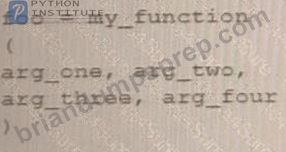
- C.
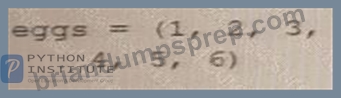
- D.
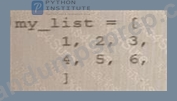
Answer: B,C
Explanation:
The correct answers are B. Option B and D. Option D . Both
options B and D are compliant with PEP 8 recommendations for line breaks and
indentation. PEP 8 recommends using 4 spaces per indentation level and breaking
lines before binary operators. In option B, the arguments to the print function
are aligned with the opening delimiter, which is another acceptable way to
format long lines according to PEP 8. In option D, the second line is indented
by 4 spaces to distinguish it from the next logical line.
NEW QUESTION # 21
Select the true statements about PEP 8
recommendations related to using blank lines. (Select two answers.)
- A. You should surround top-level functions and class definitions with one blank line.
- B. You should not put any blank lines between groups of imports.
- C. You should surround method definitions inside classes by a single blank line.
- D. You should surround top-level functions and class definitions with two blank lines.
Answer: C,D
Explanation:
The correct answers are C and D. PEP 8 recommends surrounding
top-level function and class definitions with two blank lines. This improves
readability by clearly separating major program units in a module. Inside a
class, method definitions should be separated by a single blank line because
methods are more closely related and need less visual separation than top-level
definitions. Option A is incorrect because imports are commonly grouped into
standard library imports, third-party imports, and local application imports,
with blank lines separating those groups. Option B is incorrect because one
blank line is insufficient for top-level functions and classes under PEP 8.
These spacing rules support clean, predictable, maintainable Python code
layout.
NEW QUESTION # 22
......
Our PCPP-32-101 study guide provides free trial services, so that you can gain some information about our study contents, topics and how to make full use of the software before purchasing. It's a good way for you to choose what kind of PCPP-32-101 test prep is suitable and make the right choice to avoid unnecessary waste. Besides, if you have any trouble in the purchasing PCPP-32-101 practice torrent or trail process, you can contact us immediately and we will provide professional experts to help you online on the PCPP-32-101 learning materials.
PCPP-32-101 Exam Dumps Collection: https://www.briandumpsprep.com/PCPP-32-101-prep-exam-braindumps.html
- PCPP-32-101 test braindumps: PCPP1 - Certified Professional in Python Programming 1 - PCPP-32-101 test-king guide - PCPP-32-101 test torrent 🧰 Download ➥ PCPP-32-101 🡄 for free by simply entering ➽ www.dumpsquestion.com 🢪 website 🍔PCPP-32-101 Exam Simulations
- PCPP-32-101 Top Dumps 🦀 PCPP-32-101 Discount 🎏 Reliable PCPP-32-101 Real Test 😢 Search for ▷ PCPP-32-101 ◁ and download it for free on [ www.pdfvce.com ] website 🌯PCPP-32-101 Exam Simulations
- Clear PCPP-32-101 Exam 🏂 PCPP-32-101 Latest Braindumps Ppt 💁 Exam PCPP-32-101 Testking ♻ Download ✔ PCPP-32-101 ️✔️ for free by simply entering ▶ www.prep4sures.top ◀ website 🎧PCPP-32-101 Online Test
- The best New PCPP-32-101 Test Materials – The Latest Exam Dumps Collection for Python Institute PCPP-32-101 🩱 Search for ➽ PCPP-32-101 🢪 and obtain a free download on ( www.pdfvce.com ) 🦔PCPP-32-101 Discount
- Python Institute PCPP-32-101 PDF Dumps - Study Whenever You Want 🥤 Search for ⏩ PCPP-32-101 ⏪ and download exam materials for free through ☀ www.testkingpass.com ️☀️ 👻Exam PCPP-32-101 Testking
- Python Institute PCPP-32-101 Exam | New PCPP-32-101 Test Materials - Free PDF of PCPP-32-101 Exam Dumps Collection Products 👣 Copy URL ⏩ www.pdfvce.com ⏪ open and search for ➥ PCPP-32-101 🡄 to download for free 🏺PCPP-32-101 Exam Simulations
- The best New PCPP-32-101 Test Materials – The Latest Exam Dumps Collection for Python Institute PCPP-32-101 🚡 Open ➡ www.pdfdumps.com ️⬅️ enter ▷ PCPP-32-101 ◁ and obtain a free download 🐜Valid PCPP-32-101 Test Objectives
- Free PDF Fantastic Python Institute - PCPP-32-101 - New PCPP1 - Certified Professional in Python Programming 1 Test Materials 💲 Easily obtain free download of [ PCPP-32-101 ] by searching on ▶ www.pdfvce.com ◀ ↪PCPP-32-101 Exam Simulations
- Free PDF Fantastic Python Institute - PCPP-32-101 - New PCPP1 - Certified Professional in Python Programming 1 Test Materials 🪑 Easily obtain { PCPP-32-101 } for free download through ➠ www.dumpsmaterials.com 🠰 💧PCPP-32-101 Guide
- 100% Pass Python Institute - PCPP-32-101 - PCPP1 - Certified Professional in Python Programming 1 –Professional New Test Materials 😺 Easily obtain free download of ▷ PCPP-32-101 ◁ by searching on ( www.pdfvce.com ) 🧑Exam PCPP-32-101 Testking
- PCPP-32-101 Certificate Exam 🏤 PCPP-32-101 Latest Braindumps Ppt 🏛 PCPP-32-101 Exam Book ⤴ Enter [ www.vceengine.com ] and search for ⇛ PCPP-32-101 ⇚ to download for free 😁PCPP-32-101 Certificate Exam
- myportal.utt.edu.tt, myportal.utt.edu.tt, myportal.utt.edu.tt, myportal.utt.edu.tt, myportal.utt.edu.tt, myportal.utt.edu.tt, myportal.utt.edu.tt, myportal.utt.edu.tt, myportal.utt.edu.tt, myportal.utt.edu.tt, myportal.utt.edu.tt, myportal.utt.edu.tt, myportal.utt.edu.tt, myportal.utt.edu.tt, myportal.utt.edu.tt, myportal.utt.edu.tt, myportal.utt.edu.tt, myportal.utt.edu.tt, myportal.utt.edu.tt, myportal.utt.edu.tt, myportal.utt.edu.tt, myportal.utt.edu.tt, myportal.utt.edu.tt, myportal.utt.edu.tt, myportal.utt.edu.tt, myportal.utt.edu.tt, myportal.utt.edu.tt, myportal.utt.edu.tt, myportal.utt.edu.tt, myportal.utt.edu.tt, myportal.utt.edu.tt, myportal.utt.edu.tt, myportal.utt.edu.tt, myportal.utt.edu.tt, myportal.utt.edu.tt, myportal.utt.edu.tt, myportal.utt.edu.tt, myportal.utt.edu.tt, myportal.utt.edu.tt, myportal.utt.edu.tt, quay.io, myportal.utt.edu.tt, myportal.utt.edu.tt, myportal.utt.edu.tt, myportal.utt.edu.tt, myportal.utt.edu.tt, myportal.utt.edu.tt, myportal.utt.edu.tt, myportal.utt.edu.tt, myportal.utt.edu.tt, myportal.utt.edu.tt, myportal.utt.edu.tt, myportal.utt.edu.tt, myportal.utt.edu.tt, myportal.utt.edu.tt, myportal.utt.edu.tt, myportal.utt.edu.tt, myportal.utt.edu.tt, myportal.utt.edu.tt, myportal.utt.edu.tt, myportal.utt.edu.tt, link.woomy.me, myportal.utt.edu.tt, myportal.utt.edu.tt, myportal.utt.edu.tt, myportal.utt.edu.tt, myportal.utt.edu.tt, myportal.utt.edu.tt, myportal.utt.edu.tt, myportal.utt.edu.tt, myportal.utt.edu.tt, myportal.utt.edu.tt, myportal.utt.edu.tt, myportal.utt.edu.tt, myportal.utt.edu.tt, myportal.utt.edu.tt, myportal.utt.edu.tt, myportal.utt.edu.tt, myportal.utt.edu.tt, myportal.utt.edu.tt, myportal.utt.edu.tt, myportal.utt.edu.tt, myportal.utt.edu.tt, myportal.utt.edu.tt, myportal.utt.edu.tt, myportal.utt.edu.tt, myportal.utt.edu.tt, myportal.utt.edu.tt, myportal.utt.edu.tt, myportal.utt.edu.tt, myportal.utt.edu.tt, myportal.utt.edu.tt, myportal.utt.edu.tt, myportal.utt.edu.tt, myportal.utt.edu.tt, myportal.utt.edu.tt, myportal.utt.edu.tt, myportal.utt.edu.tt, myportal.utt.edu.tt, myportal.utt.edu.tt, myportal.utt.edu.tt, myportal.utt.edu.tt, wanderlog.com, mayagriffiths253.blogspot.com, nvinio.com, Disposable vapes
DOWNLOAD the newest BraindumpsPrep PCPP-32-101 PDF dumps from Cloud Storage for free: https://drive.google.com/open?id=1Su-XZlQmcq0-XnE3M0blm-F3mVAXY9x1


Comments
Post a Comment